Showing posts with label lathe. Show all posts

Model Car

| 10/15/2010 | 0 comments |
Considering the craftsmanship on this model car as well as the size, I don't think it's fair to call it a toy!

Here are some photos of my homemade 'Rolls Royce,' my "Project Heavy Roller."

The Shopsmith and its Bandsaw were my main tools.  For patterns, I mostly scaled-up a tiny antique bookend I have, which has a miniature classic car on it.

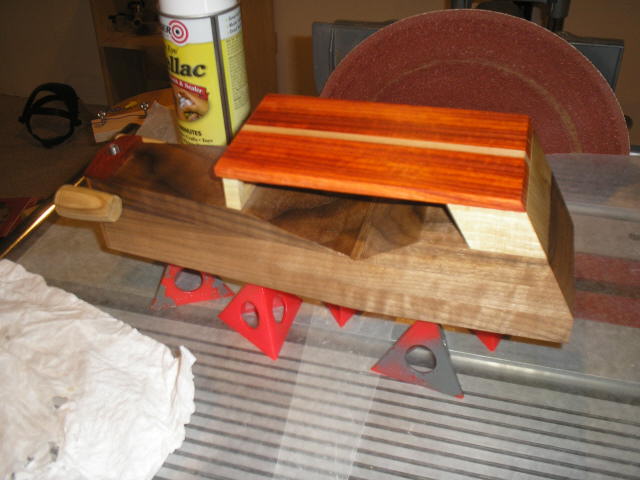
I roughly cut and bored some walnut wheels to accept some 6203 bearings I had on hand.  After initial turning on the Lathe, I epoxied the bearings inside the wheels, then used a simple jig to turn the glued bearing/wheel combinations against the 12" sanding disk, so that their perimeters were dead true and concentric.

The Drum Sander was very helpful for shaping the wheel-wells of the fenders in a ganged fashion.

Horizontal Boring is one of my favorite operations on the Shopsmith. When using drill-bits, I probably do 70% of my jobs in horizontal mode and 30% in drill-press vertical mode.  Using horizontal-boring allowed me to put dowel-holes in my "headlight blank pieces" prior to turning them, and put dowel-holes in the "engine cover & hood" block, all at precise orientations.  After turning my headlights on the lathe, I just doweled them to the body and they aimed perfectly straight with no fuss at all.

Some steps of the assembly are shown while the woods were fresh (walnut, padauk, cherry, maple, zebrawood, myrtle).   There is also a "aged one year" photo showing how the cherry and padauk have darkened while the walnut has lightened slightly.


Best Regards

Chris
Indianapolis
r

Curio Table

| 9/16/2010 | 2 comments |
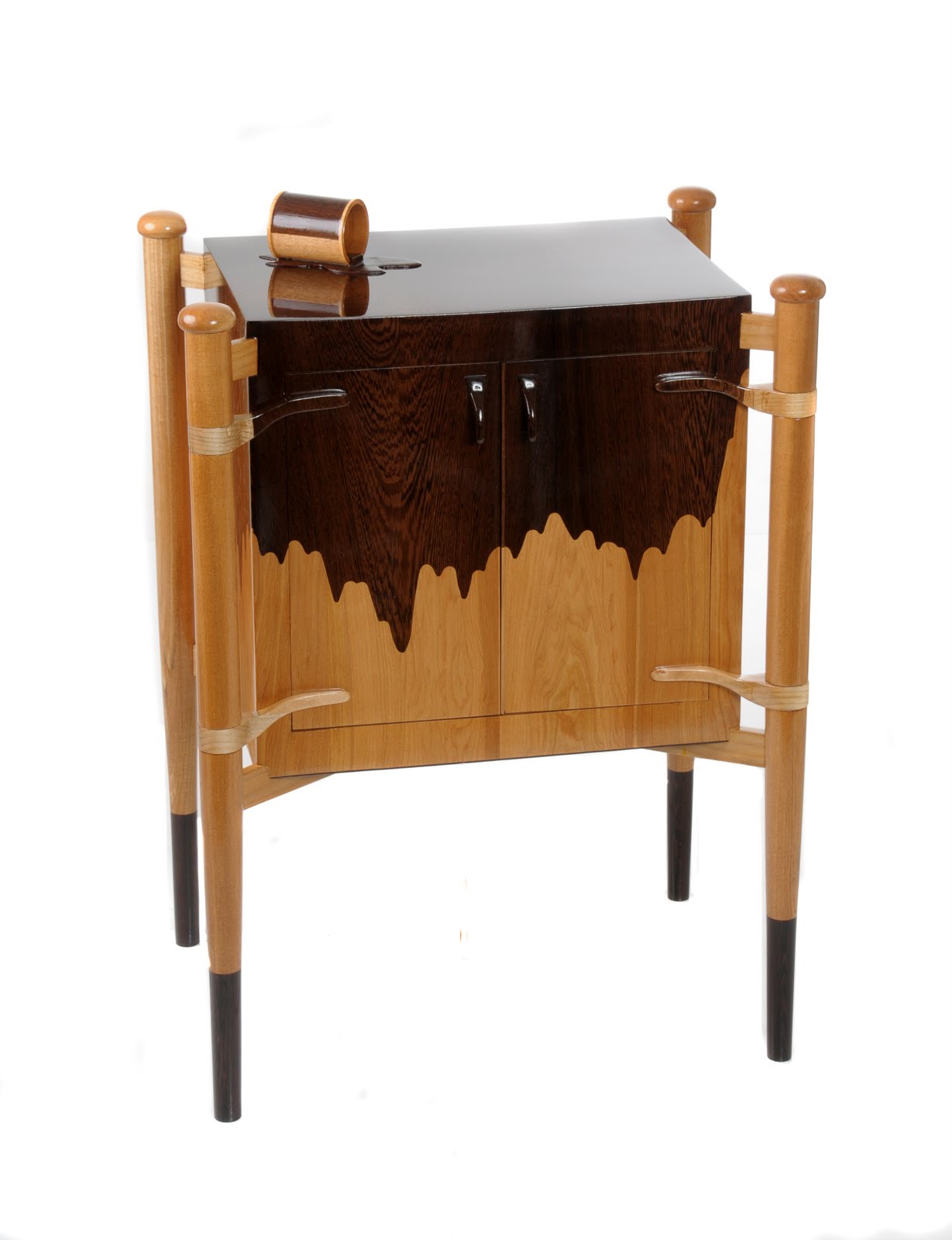
This stunning curio table was built by Paul M.  Paul used all 5 main functions of his Shopsmith 10ER. Here's what he has to say about using the Shopsmith 10ER on this project:

The veneered "Curio Cabinet" is a good example of the precision that can be achieved with even the oldest models of Shopsmith. The most critical fits in this piece are the matched grain miters on the corners. With no framing inside the miter must be a perfect fit to glue properly. If the miter is open on the outside the corner is ruined. If the miter is open on the inside, there is no glue joint. To top it off, you can't keep re-cutting a joint because not only will it ruin the grain match, but all the other corners will have to be altered to size and they are all grain matches. You only get one chance to get it right. This was accomplished easily on my 10 ER, a tool that many would dismiss as a poor choice for this because it has a tilting table and limited mitering width. I constructed a very simple miter sled for the job and because the table and alignment of the 10ER were accurate and rigid the sled worked perfectly. This is only the most obvious example but it relates to one of the biggest "negatives" blamed on the Shopsmith. My 10 ER will not produce "production efficiency" because of the changeovers required between functions but it was never meant to. What it will produce is precision results.


The full build was documented with pictures that can be seen in this photo album.

Beauty shots of the final product are in this photo album.
Table Saw
Disc Sander


Drill Press
Horizontal Boring Machine
Lathe